
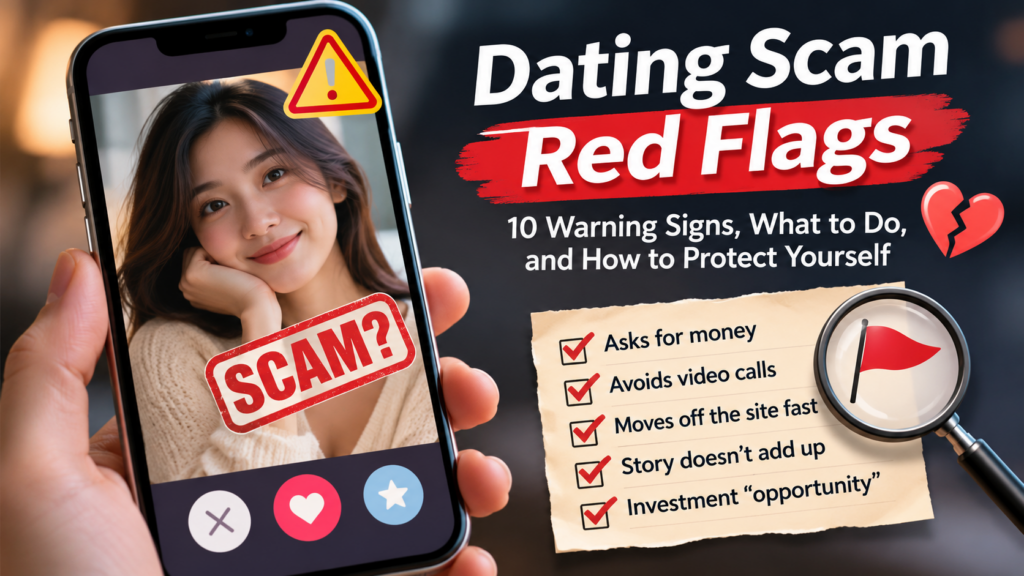
Romance scam red flags include too-perfect profiles, pressure to leave the dating site, fast declarations of love, refusing video calls, and any request for money or cryptocurrency. Most members are genuine, but knowing these patterns helps you spot fake profiles early.
The good news is that romance scams follow patterns. Once you know what those patterns look like, they become much easier to spot early, before anyone gets hurt. This guide covers the most common red flags we see in international and Asian dating, what to do if something feels wrong, and how to protect yourself while still staying open to a real connection.
Why does international dating attract so many scammers?
International relationships are built on distance. Couples often spend months getting to know each other by message and video before they meet, and travel, visas, and time zones are a normal part of the story. That is exactly what makes them attractive to scammers: a fake “partner” can always explain why they cannot meet yet, and a request for help with a flight or a visa can sound believable.
Genuine long-distance relationships do involve real costs and real delays. The difference is in how those costs are handled, and that is where most of the red flags below come in.
10 red flags to watch for
1. The profile looks too perfect
Professional-quality photos, a model-like appearance, very few pictures, and a vague bio are a common combination on fake profiles. Scammers often use photos stolen from social media accounts or modeling portfolios. One beautiful photo is not proof of anything, but a profile that looks like an advertisement deserves a closer look.
What to do: Run a reverse image search on their photos using Google Lens or TinEye. If the same pictures appear under different names, on stock photo sites, or on an influencer’s account, you have your answer.
2. They want to leave the site immediately
One of the most consistent warning signs is pressure to move the conversation to WhatsApp, Telegram, Line, or personal email within the first few messages. Off the platform, there is no reporting button, no moderation, and no record the site can review.
On AsianThrill, phone numbers and email addresses are blocked inside messages and profile text for this reason. When you are both ready to share contact details, you can use the Request Phone or Request Email option on a member’s profile, which gives the other person a clear choice to accept or decline. If someone keeps trying to get around this, treat it as a warning.
3. Intense feelings, very fast
“I’ve never felt this way before.” “I think you’re my soulmate.” “I want to spend my life with you.” Hearing this within days of first contact is called love bombing. Real feelings take time to develop. Scammers rush the emotional side because a person who feels deeply attached is more likely to help when the “emergency” arrives later.
4. They always have a reason not to video call
The camera is broken. The internet is too slow. They are on a military base, an oil rig, or a ship where calls are not allowed. A real person who is interested in you will find a way to show their face, even briefly. Repeated excuses over weeks are one of the strongest signs that the person in the photos is not the person typing.
What to do: Ask for a short video call early, within the first week or two of regular messaging. It does not need to be long or formal. If they refuse every time, step back.
5. Messages feel copied and pasted
Scammers often manage many conversations at once from scripts. You may notice long, poetic messages that do not respond to anything you actually said, the same phrases repeated, or answers that ignore your direct questions. If you ask something specific about their day, their city, or their job and keep getting general replies, pay attention.
6. Their story does not add up
Details that shift over time are a red flag: a job that changes, a city that moves, an age that does not match their photos, or a background that sounds impressive but is hard to verify. Common scam identities include doctors working overseas, engineers on offshore projects, military officers on deployment, and successful business owners who travel constantly.
7. Any request for money
This is the clearest red flag of all. It may come as a medical emergency, a family crisis, a customs fee for a package, a visa or passport cost, a plane ticket so they can finally visit you, or a temporary problem accessing their own bank account. It often arrives after weeks of warm, consistent conversation, when you feel most connected.
Scammers usually ask for payment methods that are hard to reverse: gift cards, cryptocurrency, wire transfers, or money-transfer apps. A request to pay with gift cards is never legitimate.
Our firm rule: never send money, gift cards, or cryptocurrency to someone you have not met in person, no matter how real the relationship feels or how urgent the situation sounds.
8. An “investment opportunity”
A newer and very costly pattern starts as romance and slowly turns into investing. Your match mentions they have been making money trading cryptocurrency or foreign currency, offers to show you how, and points you to a platform or app. Early “profits” look real, which encourages you to deposit more. When you try to withdraw, there are fees, taxes, or account problems, and the money is gone.
If someone you met on a dating site brings up investing, especially in crypto, end the conversation about money right there.
9. Requests for personal or financial information
Be wary of anyone who asks for your home address early, photos of your ID or passport, your bank details, or one-time verification codes sent to your phone. Verification codes in particular should never be shared with anyone; they are often used to take over accounts.
10. Pressure, guilt, and secrecy
“If you really loved me, you would help.” “Please don’t tell your family about us yet, they won’t understand.” Scammers try to isolate you from the people who would spot the problem. A healthy relationship can handle your friends and family knowing about it.
A note on genuine long-distance costs
Real international couples do face real expenses: flights, visas, and travel. The safe way to handle them is simple. If you decide to visit someone or help with travel, book and pay for flights and hotels yourself, directly with the airline or hotel, in your own name. Never send cash for someone else to make the booking. A genuine partner will understand this, and someone who becomes angry or pushy about it is showing you who they are.
How to protect yourself
- Video call early. It is the single most effective check you can do.
- Reverse search their photos. It takes less than a minute.
- Keep the conversation on the site until you have video called and feel confident.
- Look for the verification badge, and understand what it means. On AsianThrill, a verified badge means the member submitted a verification selfie that was checked by AI and then reviewed by our team against their profile photos. It confirms the face in the photos belongs to the person who verified. It is not a background check, and it does not replace your own judgment.
- Talk to someone you trust. A friend who is not emotionally involved will often see a problem before you do.
- Never send money to someone you have not met in person.
- When you meet, choose a public place, arrange your own transportation and accommodation, and tell someone where you will be.
What to do if something feels wrong
- Stop sending money or information. Do not send “one last payment” to fix the problem, even if they promise to repay you.
- Report the profile to us. Use the Report Abuse link in the site footer and include the member’s name and what happened. Reports help us find and remove fake accounts before they reach other members.
- Contact your bank or card provider right away if you have sent money. The sooner they know, the better the chance of stopping a transfer.
- Report the scam to the authorities. In the United States, you can report to the Federal Trade Commission at ReportFraud.ftc.gov and to the FBI’s Internet Crime Complaint Center at ic3.gov. In other countries, contact your national fraud reporting center or local police.
- Watch out for “recovery” scams. After a scam, victims are sometimes contacted by people who claim they can get the money back for a fee. This is another scam.
- Be kind to yourself. Romance scammers are skilled and organized. Being targeted says nothing about your intelligence. It says that you were open to love, which is not a mistake.
How we fight fake accounts at AsianThrill
Keeping fake profiles off the site is an ongoing job. We review new accounts for patterns such as clustered sign-ups from the same network, recycled photos, and identical opening messages sent to many members, and we remove accounts that match. We block contact details in messages so conversations cannot be quietly moved off the platform, and we offer free selfie verification so members can show they are real. You can read about one recent case in how our Trust & Safety team caught a coordinated fake-account network.
No system catches everything, which is why your reports matter. If something feels off, tell us.
The bottom line
You do not need to be suspicious of everyone to stay safe. Most members are genuine, and real connections happen here every day. Just keep a few simple rules in mind: video call early, keep conversations on the site until you are confident, and never send money to someone you have not met. Those three habits stop the large majority of romance scams before they start.
For more practical advice, see our full Dating Safety guide.
